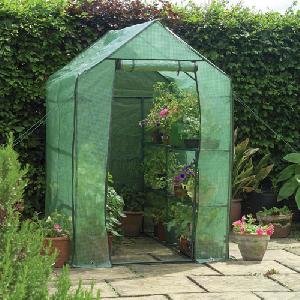
You've probably seen these before. They are sold worldwide in most home and garden supply shops. I thought I would use this as the basis of my first proof-of-concept CD-OS project because it is so common. A complete fully automated aquaponics lab the size of a broom closet designed to provide vegetables, fruits, salad and fish to complement a food storage program.
My planned design had four requirements :
- Should fit into a broom closet.
- Completely automated and monitored by CD-OS around the clock using ubiquitous modbus components and controls, preferably over a cheap Modbus TCP-IP router.
- Should run on extremely low current and voltage, preferably a solar panel or two.
- Must be temperature controlled so as to maintain a hothouse environment even in arctic conditions. (Ice Age II, Nuclear winter or supervolcano eruption)
I ordered a couple space blankets off EBay at about .99 cents each and they arrived tonight. You can often find these mylar foil sheets sold as "emergency blankets" or "survival blankets."

The number one use of the mylar foil was to reflect as much light as possible inside the hydroponics tent so none was wasted. I knew that the mylar had some insulating capacity but was expecting it would need supplementation with a low current heat source which I also ordered last week and have already tested.
The one drawback of LED lighting strips is that they don't generate much heat but if they even generate a little that might be enough to heat the interior considerably with the mylar foil insulation. I have a low current device to heat the fish water to keep it from freezing and a low current air heater that is intended to only come on when it is needed to "top off" the internal temperature. All of these components will be part of an integrated design that is intended to be plug-n-play with a matching CD-OS module that is ultimately implemented as nothing more than a couple Lua scripts for the server.
So far I have spent about a hundred bucks including all modbus parts for this closet but I expect there are even cheaper ways to construct it. The big challenge is building a modbus component for measuring water PH without spending $500.00 on that sensor. I think I have it figured out. I bought a $9.00 PH sensor that is supposed to plug into a dedicated unit that I am going to interface with a DAC to modbus circuit with perhaps $10.00 worth of electronic parts. I have not built that yet but I figure it will take a bit of testing to get that right. I am going to connect the cheap PH sensor across an existing modbus voltage meter sold on Ebay for around $10.00 and hope it can be calibrated to yield the right values. If that works it will be the only tough component to provide inexpensively.